Most "how to implement DevOps" guides assume that buying the tools and holding a few cross-team standups will move the needle. The data says otherwise. The 2024 Accelerate State of DevOps Report, drawing on more than 39,000 professionals, found the industry is not improving on aggregate: independent analysis of that data shows the high-performing cluster shrank from 31% to 22% of teams while the low-performing cluster grew from 17% to 25%. Tooling alone does not raise delivery performance. What follows is a sequence that does, framed for directors and senior engineers who have already been burned by a transformation that stalled at slide 40 of a vendor deck.
Start by measuring, not by reorganizing
Before you touch the org chart, instrument the four metrics that have survived a decade of DORA research: deployment frequency, change lead time, change failure rate, and time to restore service. These are not vanity dashboards. They are the only widely validated way to know whether a change to your pipeline made delivery better or worse, and they double as concrete targets. Elite performers deploy on demand, keep change lead time under a day, hold change failure rate around 5%, and restore service in under an hour.
The non-obvious finding is that speed and stability are not a trade-off. Teams that deploy more frequently also fail less and recover faster, because small, frequent changes are easier to reason about and reverse. If your current narrative is "we move slowly so that we stay safe," the data contradicts you, and that conversation is worth having with your leadership before any reorg. Baseline these four numbers now so that every later step is judged against them rather than against opinion.
Build the platform before you scale the practice
The single biggest shift in how DevOps is implemented at scale is that the "you build it, you run it" ideal has run into the wall of cognitive load. Modern toolchains and distributed architectures ask each developer to understand far too much. The answer the industry converged on is platform engineering: a dedicated team that provides reusable services, paved roads, and guardrails as an internal product. Gartner predicts that by 2026, 80% of large software engineering organizations will have platform engineering teams, up from 45% in 2022, and DORA reports that roughly 89% of organizations already run internal developer platforms.
For a regulated or high-scale team, this is where compliance becomes cheap instead of painful. Encode your controls into the paved path: signed artifacts, mandatory test gates, policy-as-code, audit logging, and pre-approved infrastructure modules. When the easy way to ship is also the compliant way, you stop relying on engineers to remember the rules under deadline pressure. Treat the platform as a product with real users, a backlog, and adoption metrics, not as a side project for whoever has spare cycles.
One caveat that the research is blunt about: platforms are not automatically a win. The 2024 DORA report found that internal developer platforms lifted team performance by roughly 10%, yet could also reduce throughput and stability when the underlying fundamentals lapsed. A platform that adds approval queues and indirection without removing toil will make things worse. Measure adoption and the four delivery metrics before and after, and kill platform features that do not pay for themselves.
Automate the path to production, then keep it honest
Automation is the part everyone already believes in, so the failure mode is subtler: teams automate the deployment and then stop. A pipeline that runs but does not enforce small batch sizes, robust automated testing, and continuous monitoring is a faster way to ship the wrong thing. The 2024 DORA data is explicit that automation pays off only when paired with these fundamentals, not when treated as a one-time setup.
Concretely, that means three things hold the line. First, small batch sizes: trunk-based development or short-lived branches so changes reach production in hours, not weeks. Second, tests you trust enough to gate on: if a red build does not block a release, the suite is decoration. Third, monitoring and feedback wired back into the team, not just an on-call dashboard nobody reads. Define service level objectives, alert on user-facing symptoms, and review change failure rate weekly. The goal is a closed loop where every deployment teaches you something measurable.
Treat AI as an amplifier, with guardrails
AI in the toolchain is no longer optional to discuss. The 2025 DORA report, based on nearly 5,000 professionals, found that 90% use AI at work and over 80% say it increased their productivity. But about 30% report little or no trust in AI-generated code, and the 2024 data put that distrust at 39.2%. That gap matters because the headline finding is uncomfortable: AI does not fix a team, it amplifies what is already there. AI correlates with higher throughput and product performance only where strong internal platforms, clear workflows, and team alignment already exist. Without robust controls, it intensifies existing weaknesses and still drags on delivery stability.
The implication for your rollout is sequencing. Stand up the platform and the delivery discipline first, then introduce AI assistance on top of paved paths where generated code passes through the same test gates, review, and policy checks as anything else. Do not let AI become a side channel that bypasses your controls, especially in a regulated context. Used inside a strong system, AI accelerates the good behaviors you have already built. Used to paper over a weak one, it accelerates the failures.
Culture is the constraint, not the slogan
Every credible source lands on the same place: tools and platforms are necessary but not sufficient. The clusters of high and low performers in the DORA data are separated less by their stack than by how they work, whether blameless retrospectives are real, whether teams own their services end to end, and whether leadership protects the time to pay down toil. The cultural work is not a kickoff workshop. It is the sustained decision to keep batch sizes small and to act on the metrics even when a deadline argues otherwise.
A realistic sequence
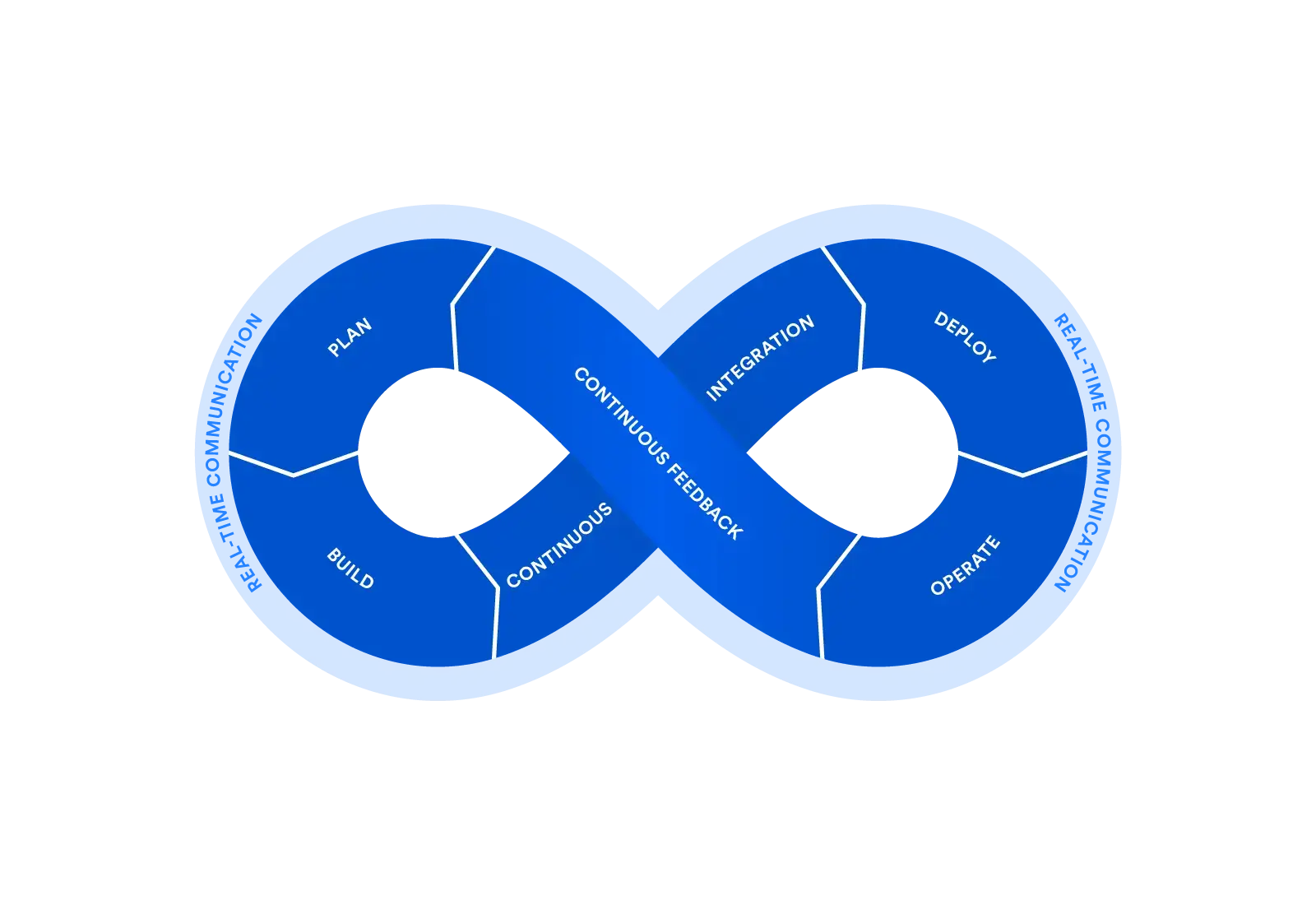
If you compress this into an order of operations: baseline the four DORA metrics; pick one or two value streams as pilots rather than a big-bang mandate; build the paved-road platform with compliance encoded into it; drive small batch sizes and trustworthy test gates through automation; wire monitoring back into the teams; then layer AI on the foundation you have proven. Expect this to be a continuous program, not a project with an end date. The teams that pulled ahead in the DORA cohort did not adopt a tool. They built a system that gets a little better every release, and then they refused to let it regress.
That is the honest version of how to implement DevOps in your organization. It is less about a methodology to buy and more about a discipline to sustain. If you want a partner who works from the same evidence base, explore our DevOps services.
Sources
- 2025 DORA Report: State of AI-Assisted Software Development - Google Cloud / DORA
- Accelerate State of DevOps Report 2024 - DORA / Google Cloud
- Platform Engineering - Gartner
- Highlights from the 2024 DORA State of DevOps Report - DX (getdx.com)