Most writing on DevOps is still pitched at people who have never run a deployment. If you are an engineering director, manager, or senior engineer at a high-scale or regulated team, you do not need another definition of "Dev plus Ops." You need to know what the evidence says works, where the current hype breaks down, and which decisions actually move delivery performance. This is that brief.
The useful frame for 2026 is not "should we do DevOps" but "is our delivery system getting measurably faster and more stable, or are we trading one for the other." That distinction is the whole game, and it is now well instrumented.
Stop arguing about DevOps. Measure it.
DevOps stopped being a philosophy you debate the moment the four DORA metrics gave it a scoreboard. They pair throughput with stability so neither can be gamed in isolation:
- Deployment frequency and lead time for changes measure speed: how often you ship and how long an idea takes to reach production.
- Change failure rate and failed-deployment recovery time measure stability: how often a release breaks something and how fast you recover when it does.
The benchmark gap is not subtle. Elite teams deploy on demand, multiple times per day, with recovery times under an hour and a change failure rate around 5%. Low performers deploy only between once a week and once a month, take a month or more to recover, and run a change failure rate near 64%. The difference in shipping cadence is an order of magnitude, and elite teams achieve it without trading away reliability. If your organization cannot state its current numbers on all four, that is the first problem to fix, ahead of any tooling purchase.
AI is now in the loop. It is a mirror, not a fix.
The center of gravity has moved. In the 2025 DORA report, drawn from nearly 5,000 technology professionals, 90% now report using AI in their daily work, a sharp jump year over year. Any honest discussion of DevOps in 2026 has to account for AI in the development lifecycle. But the headline finding deserves to be read carefully by anyone making bets here.
DORA's central conclusion is that AI is an amplifier, a mirror. It magnifies the strengths and weaknesses a team already has. It does not repair a broken delivery process; it lets a team with weak foundations ship low-quality work faster. That is consistent with developer sentiment on the ground: roughly 30% still report little or no trust in AI-generated code. The technology raises individual output. Whether that output becomes value or incident volume depends entirely on the system it lands in.
There is a measurable tradeoff, and it is the one your existing instrumentation was built to catch. The 2024 DORA research found that AI adoption correlates with higher individual productivity and job satisfaction but with reduced delivery stability, more change failures and slower recovery. In 2024 terms, each 25% rise in AI adoption was associated with roughly 2.1% higher individual productivity and 2.6% higher job satisfaction, but about 1.5% lower delivery throughput end to end. AI can make a developer faster while making the system slower. The only way to see that happening is to watch the four metrics while you roll it out.
The practical implication for a regulated or high-scale team: treat AI-assisted code as code from a fast but junior contributor. The controls that already protect your pipeline, review, automated testing, progressive delivery, fast rollback, are exactly the controls that determine whether AI is a net gain. If those controls are thin, AI will surface that fact quickly and expensively.
Platform engineering is where the budget should go
The clearest industry evolution of DevOps is platform engineering, and it is the angle most worth a senior team's attention. Gartner predicts that by 2026, 80% of large software engineering organizations will have established platform engineering teams, up from 45% in 2022. These teams act as internal providers of reusable services, components, and tooling, exposed through self-service internal developer platforms.
The motivation is concrete. A decade of "you build it, you run it" pushed an enormous toolchain onto every developer, and the cognitive load became a tax on delivery. A platform team's job is to pave the golden path: standardized CI/CD, Infrastructure as Code for reproducible environments, observability, and policy-as-code wired in by default rather than reassembled by each squad. For regulated teams this is the highest-leverage move available, because controls baked into a self-service platform are auditable and consistent in a way that controls living in tribal knowledge never are.
One caveat the data demands. The 2024 research found that internal developer platforms raise productivity and organizational performance but can decrease change stability and throughput if introduced carelessly. A platform is a product. If you ship it without a user-centric focus, you have built another layer your engineers route around. The same instrumentation applies: a platform that is working should move your DORA numbers in the right direction, not just generate adoption slides.
The organizational factors outweigh the tooling
The most counterintuitive finding for engineers who like clean architecture is that the strongest predictors of high performance are not technical. Across years of DORA research, the biggest drivers of quality, speed, and lower burnout are a user-centric focus, stable organizational priorities, transformational leadership, strong documentation, and psychological safety. Teams that know who they are building for and are not whiplashed by shifting priorities outperform teams with better pipelines and worse focus.
This is why "DevOps as a culture of collaboration and continuous improvement" survives the skepticism it deserves. It is not a slogan; it is what the measurements keep pointing back to. Automation, CI/CD, and IaC are necessary. They are not sufficient, and they are not where the largest remaining gains live for most organizations.
What to actually do next
If you take three things from this brief: instrument the four DORA metrics before you change anything, so you can tell whether interventions help or hurt. Treat AI adoption as a controlled rollout watched through those same metrics, not a productivity press release. And invest in platform engineering as a product with real users, since that is where reduced cognitive load and embedded controls compound, particularly under regulatory pressure.
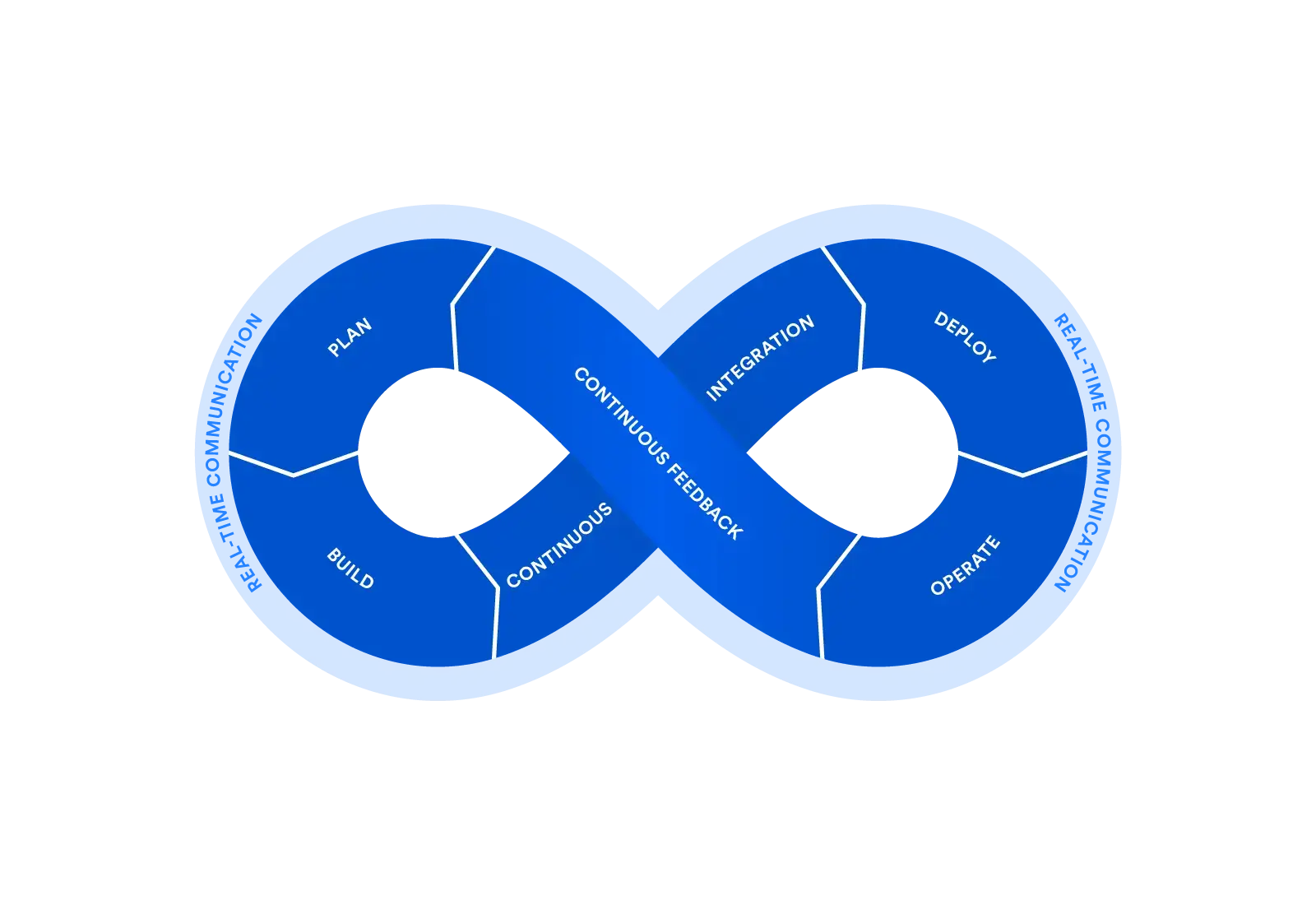
DevOps at this point is less a thing you adopt and more a feedback loop you run with discipline. The teams pulling ahead are not the ones with the most tools. They are the ones who can see, in numbers, whether each change made them both faster and more reliable, and who are willing to roll back the ones that did not. If you want a partner who works from that evidence rather than the brochure, that is how Expeditious Software approaches DevOps.
Sources
- State of AI-assisted Software Development 2025 (DORA Report), DORA / Google Cloud
- Accelerate State of DevOps Report 2024, DORA / Google Cloud
- Platform Engineering, Gartner
- DORA Metrics: The four key metrics and elite vs low performer benchmarks, Octopus Deploy