Ask ten teams how DevOps works and you get ten taxonomies of stages, tools, and Venn diagrams. None of that tells you whether it is working. DevOps is not a pipeline diagram or a job title; it is a closed-loop control system for software delivery, where every change is small, automated, measured, and reversible. The useful question for an engineering leader is not "what are the stages of DevOps" but "what does a working DevOps system optimise for, how do you know it is improving, and what changes when AI writes a third of your diffs." This piece answers those, grounded in the largest body of evidence the field has - DORA's research program, now in its 10th-plus year.
What "working" means: the four metrics, not the toolchain
The most durable contribution of DevOps research is a measurement model, not a methodology. DORA's four key metrics, introduced in 2013 and now the industry standard, give you a way to define delivery performance that survives any tooling change:
- Deployment frequency - how often you ship to production. A proxy for batch size and the health of your release path.
- Change lead time - time from commit to running in production. Measures the friction in your pipeline, not your developers' typing speed.
- Change failure rate - the share of deployments that cause a degradation requiring remediation.
- Time to restore service - how fast you recover when something breaks.
The first two measure throughput; the last two measure stability. The central, counter-intuitive finding of two decades of research is that these are not a trade-off. High performers are fast and stable, and they get there through the same mechanism: small changes, deployed often, behind automated tests and one-button rollback. If your "DevOps transformation" has improved deploy frequency while change failure rate climbs, you have not adopted DevOps - you have just removed a safety gate. Pick these four as your scoreboard before you argue about tools. This is evidence-based: the 2024 report drew on more than 39,000 professionals, and the 2025 edition added nearly 5,000 respondents plus over 100 hours of qualitative interviews.
The mechanism: a feedback loop, optimised for small changes
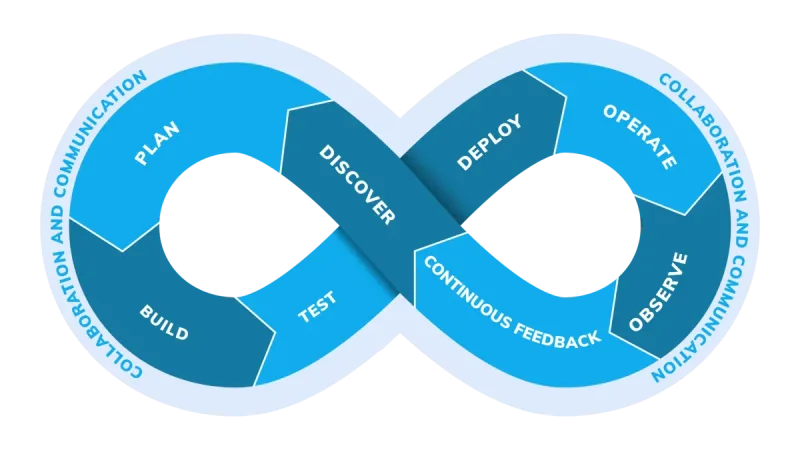
How DevOps actually produces those numbers is unglamorous and specific. A developer commits a small change to version control. Continuous integration builds and tests it within minutes, against a suite trustworthy enough that a green run is a deploy decision, not a suggestion. Continuous delivery turns every passing build into a release candidate, deployable on demand. Infrastructure is defined as code, so environments are reproducible and a rollback is a redeploy of a known-good artifact rather than a heroic night. Production is instrumented so that monitoring, traces, and error budgets tell you within minutes whether the change is healthy.
Each property exists to shrink the loop. Small batches make failures cheap to diagnose and cheap to revert. Automated tests move the cost of a defect from production back to the pull request. Fast restore means you can tolerate a non-zero failure rate, which in turn lets you move fast without pretending you will never be wrong. For teams in regulated or high-scale environments, this is also your audit and compliance story: every change traced from commit to deploy, every gate automated and logged, every environment described in code rather than in tribal memory. The loop is the control. The tools are interchangeable implementations of it.
AI is now in the loop, and it is an amplifier, not a fix
You cannot describe how DevOps works in 2026 without addressing AI-assisted delivery, because it is no longer marginal. By 2025, 90% of respondents reported using AI at work and over 80% believed it increased their productivity - yet 30% still report little or no trust in AI-generated code. That tension is the point.
The headline finding of the 2025 DORA report is blunt: AI is an amplifier. It magnifies a team's existing strengths and weaknesses. Teams with strong internal platforms, fast feedback loops, automated testing, and clean version control convert AI into real gains. Teams without those foundations get faster at producing changes their delivery system cannot safely absorb. The return comes from the organisational system, not the tool.
The 2024 data quantifies the failure mode. A 25% increase in AI adoption correlated with measurable lifts in documentation, code quality, and review speed - but also an estimated 1.5% drop in delivery throughput and a 7.2% drop in delivery stability. The mechanism, flagged by InfoQ's analysis, is that AI tends to increase change and batch size, and larger changesets are riskier. That is a direct collision with the one practice DevOps research is most certain about: small, frequent, well-tested releases. The practical implication for leaders is not "ban AI" or "buy more AI." It is to treat your delivery foundations - test coverage you trust, CI you cannot bypass, batch-size discipline in review - as the prerequisite that determines whether AI is leverage or a stability tax.
Where this is heading: from DevOps to platform engineering
The next structural shift is already visible. As DevOps practices scaled, the cost of every team running its own bespoke pipeline, security scanning, and infrastructure became the new bottleneck. The response is platform engineering: a dedicated team that treats the internal delivery platform as a product, offering paved-road, self-service tooling so application teams ship without reinventing the plumbing. Gartner predicts that by 2026, 80% of large software engineering organisations will have platform engineering teams, up from 45% in 2022. DORA corroborates the demand side: roughly 90% of organisations have adopted at least one internal platform.
This is not a repudiation of DevOps; it is its operationalisation at scale. The four metrics still define success, the loop still does the work - but the loop is now provided as a product so that "the right way to ship" is also the easy way. For regulated teams, an internal platform is where compliance controls, security gates, and traceability stop being per-team discipline and become defaults nobody can route around.
What to take away
DevOps works as a feedback system that makes change cheap, fast, and safe to reverse, measured by four metrics that balance speed against reliability. Adopt the scoreboard first. Invest in the foundations - automated testing, trustworthy CI, infrastructure as code, real observability - because those are what convert both human and AI effort into throughput without sacrificing stability. Then consolidate that capability into a platform so the safe path is the default path.
That is the work Expeditious Software does: building the delivery systems, internal platforms, and measurement underneath them rather than selling the diagram. If you want a delivery loop that holds up under scale, regulation, and AI-assisted development, start with our DevOps services.
Sources
- Announcing the 2025 DORA Report: State of AI-Assisted Software Development - Google Cloud (DORA), 2025
- State of AI-assisted Software Development 2025 - DORA / Google Cloud, 2025
- Highlights from the 10th DORA report (Accelerate State of DevOps Report 2024) - Google Cloud (DORA), 2024
- 2024 Accelerate State of DevOps Report Shows Pros and Cons of AI - InfoQ, 2024
- Unlock Infrastructure Efficiency with Platform Engineering - Gartner, 2023