If you run a high-scale or regulated engineering organization, "should we hire a DevOps service provider?" is not really a question about tooling. You already have CI runners, a cloud account and an incident channel. The real question is whether buying outside expertise will measurably move your delivery metrics, your cloud bill and your audit posture - or whether it will just add a vendor invoice on top of the problems you already have. This article treats it as that kind of capital-allocation decision, not a sales pitch.
The honest answer is "it depends, and here is what it depends on." Below are the advantages that hold up under scrutiny, the conditions under which they materialize, and the failure modes a good provider is supposed to prevent.
This is now the mainstream operating model, not a niche
The first thing to understand is that delivering DevOps capability "as a service" - whether through an internal platform team or an external partner - has already won the architectural argument. Gartner forecasts that by 2026, 80% of large software engineering organizations will run platform engineering teams that act as internal providers of reusable services, components and tools for application delivery, up from 45% in 2022. The unit of value is a provided, paved-road capability that application teams consume on demand.
That reframes the buy-versus-build decision. You are not choosing whether to treat DevOps as a service; the industry has already done that. You are choosing who staffs and operates that service, how fast you want it stood up, and whether you have the in-house depth to run it well. A service provider is one credible answer to "we need this capability in quarters, not years, and we do not want to learn every lesson the expensive way."
The advantage is expertise and governance, not tooling
The most important caveat comes from the data that is friendliest to DevOps in general. DORA's 2024 Accelerate State of DevOps Report finds that internal developer platforms improve individual productivity, team performance and organizational performance - but it explicitly warns that platforms without good governance can reduce change stability and throughput. A platform is a force multiplier in both directions. The same report notes that AI adoption raised individual productivity and job satisfaction while it could hurt delivery stability and throughput, which makes the same point a different way: capability without discipline is not a win.
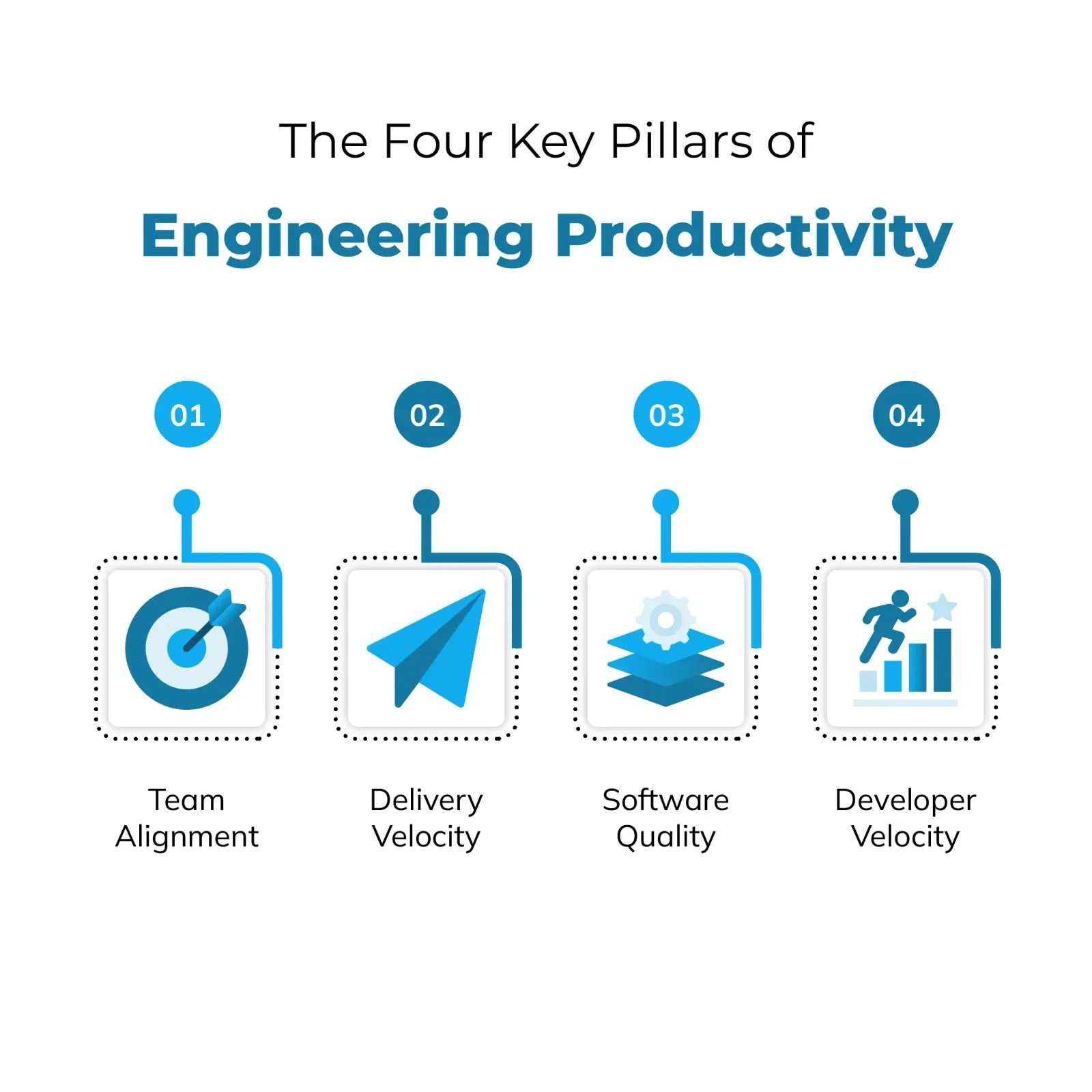
This is the strongest argument for a provider, and also the strongest reason to be skeptical of a weak one. The value is not "they have Terraform and a pipeline template." The value is whether they bring the governance, golden paths and operational practices that keep a platform from degrading your delivery metrics. DORA centers software delivery performance on four measures - deployment frequency, lead time for changes, change failure rate and time to restore service - and the gap between the strongest and weakest performers on them is large enough that closing even part of it is worth real money. A provider earns its fee by moving you toward the high end of those four metrics and proving it with numbers - not by shipping a reference architecture and leaving.
Practical test for any provider: ask how they will instrument and report the four DORA metrics for your teams, what their target change-failure rate is, and what governance they put around the platform so it does not quietly regress throughput. If the answer is a tool list, keep looking. If the answer is about guardrails, paved roads and measured outcomes, you are talking to someone who has read the same research you have.
Cost-effectiveness: the cloud-waste argument is real and quantified
The cost case for a provider used to be hand-wavy. It is not anymore. Flexera's 2025 State of the Cloud report found that 84% of organizations name managing cloud spend as their top cloud challenge, respondents self-estimate that about 27% of cloud spend is wasted, and budgets already overrun by about 17%. For most organizations at scale, that waste is a larger, more recoverable number than any headcount line a provider would replace.
The market response is telling: in the same report, 60% of organizations turn to managed service providers, and a growing majority adopt FinOps practices to bring spend under control. That is the cost-effectiveness argument stated honestly: you are not paying a provider to save money in the abstract, you are paying them to recover a quantifiable slice of the roughly 27% you are currently wasting, and to put FinOps discipline and right-sizing into your delivery process so the waste does not creep back. Run that as a simple calculation against your own cloud bill before you sign anything. If a provider cannot point at a credible percentage of recoverable spend, the cost story does not hold and you should weigh them on delivery speed alone.
Security and CI/CD: this is where automation actually compounds
Security has quietly become the headline reason to bring in serious DevOps expertise. GitLab's 2024 Global DevSecOps Report, covering 5,315 professionals, found that security is now the number-one IT investment priority - cloud computing fell from first to fifth - and that C-level leaders name "more secure applications" as the top benefit of DevSecOps. Two-thirds of teams now report a mostly or fully automated software development lifecycle.
The same survey exposes the gap a competent provider is supposed to close: 67% of teams use 25% or more open-source code, but only 21% generate a software bill of materials. That is exactly the kind of supply-chain control that gets skipped under delivery pressure and gets you in trouble during an audit or after a CVE. Embedding security into automated CI/CD - SBOM generation, dependency and container scanning, policy-as-code gates, signed artifacts and provenance - is the work that pays off precisely because it runs on every commit instead of once a quarter. For regulated teams, this is also where a provider with audit experience earns its keep; see our note on DevOps under DORA-style regulated delivery and the broader DevSecOps distinction for why "security throughout the lifecycle" is a delivery property, not a checklist.
Reliability and scale: buy the operating model, not just capacity
Reliability and scalability are the advantages most often oversold, so be precise about what you are buying. Containerization, autoscaling and infrastructure-as-code give you elastic capacity, but capacity is the easy part. The hard part is the operating model: SLOs and error budgets, blameless incident response, on-call discipline, change management that does not throttle throughput, and observability that catches regressions before customers do. That is what shows up as a low change-failure rate and a fast time-to-restore - two of the four DORA metrics - and it is mostly culture and practice, not infrastructure.
A provider is worth hiring here when they transfer that operating model and the runbooks to your teams, not when they make themselves a permanent dependency in your incident path. Insist on a knowledge-transfer plan and an exit ramp. The goal is a platform your engineers can own.
So - is it worth it?
Yes, under specific conditions, and the conditions are the whole answer. It is worth it when you need elite-level delivery practice faster than you can hire and grow it internally; when a real fraction of your cloud spend is recoverable; when security and supply-chain controls have to be embedded into CI/CD rather than bolted on; and when the provider commits to measured outcomes on the four DORA metrics and to handing the platform back to your teams. It is not worth it when you are buying tooling you could template yourself, when there is no governance behind the platform, or when the engagement is structured to keep you dependent. Hold any provider to that standard - including us. If you want to pressure-test the decision, start with the factors that actually distinguish a strong DevOps partner and bring your own numbers to the conversation.
Sources
- Accelerate State of DevOps Report 2024 - DORA / Google Cloud
- Gartner Identifies the Top Strategic Trends in Software Engineering for 2025 and Beyond - Gartner
- New Flexera Report Finds that 84% of Organizations Struggle to Manage Cloud Spend - Flexera
- GitLab devsecops survey finds progress, new priorities (2024 Global DevSecOps Report) - InfoWorld